Overview
An international group of researchers, led by Chubu University and Tohoku University, has achieved the world’s first direct observation of muonic molecules in resonance states using a high-resolution x-ray detector. These states are critical in determining the reaction rate of muon catalyzed fusion (µCF), a process that utilizes elementary particles known as muons. Within muonic molecules, the nuclei are confined in extremely close proximity, enabling nuclear fusion to occur even at room temperature without the need for plasma. Furthermore, the researchers quantitatively identified the population ratio of each quantum mechanical state.
This achievement illuminates the previously elusive dynamics of the molecular formation process, successfully resolving a long-standing discrepancy between theoretical understanding and experimental results.
This work not only elevates the understanding of µCF reactions to a level at which individual quantum states can be resolved, but also significantly advances the foundation for enhancing the efficiency of µCF as a future energy source.
The research findings were published in Science Advances, a journal of the American Association for the Advancement of Science (AAAS), at 3:00 AM (JST) on April 16.
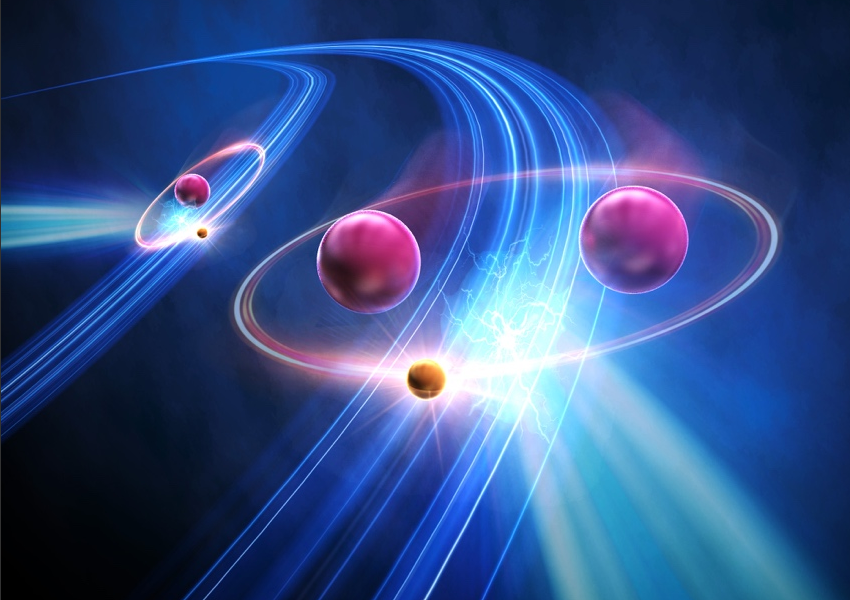
- This figure illustrates the reaction pathway via a resonance state (foreground), as revealed in this study, and the conventionally assumed pathway (background). In the foreground, muonic molecule (ddµ), consisting of two deuterons (d) and a muon (µ), is depicted emitting x-rays from a resonance state. In contrast, the background shows x-ray emission from a muonic atom (dµ). The observations demonstrate that the pathway via the resonance state plays a dominant role in µCF.
Research Details
An international group of researchers, led by Assistant Professor Yuichi Toyama and Professor Shinji Okada of the Center for Muon Science and Technology at Chubu University, alongside Associate Professor Takuma Yamashita and Professor Yasushi Kino of the Department of Chemistry at Tohoku University, has succeeded in the world’s first direct observation of muonic molecules in resonance states. These states determine the reaction rate of muon catalyzed fusion (µCF). The observation was achieved by high-resolution x-ray spectroscopy with cryogenic detectors. Furthermore, the researchers quantitatively identified the population ratio of each quantum state. This achievement illuminates the previously elusive dynamics of the muonic molecular formation process, successfully resolving a long-standing discrepancy between theory and experiment. This work not only elevates the understanding of µCF reactions to a level at which individual quantum states can be resolved, but also significantly advances the foundation for enhancing the efficiency of µCF as a future energy source.
Currently, research aimed at the practical application of nuclear fusion—the process of fusing hydrogen nuclei—is underway worldwide. In principle, fusion offers highly safe energy with no risk of runaway accidents. It utilizes fuel easily extracted from seawater, and produces clean energy without carbon dioxide emissions.
To initiate conventional fusion, methods are used that involve generating plasma at extremely high temperatures and confining it with magnetic fields, or instantaneously compressing fuel with lasers to achieve high-temperature, high-density plasma. In contrast, in µCF, the electrons in hydrogen molecules are replaced by muons, compressing the internuclear distance of the molecules by 1/200. Within these muonic molecules, the nuclei are confined in exceedingly close proximity, allowing fusion to occur even at room temperature without the need for plasma. For µCF to occur efficiently, the rapid formation of muonic molecules is crucial. However, muon atomic and molecular processes leading to the formation of these muonic molecules were the subject of a long-standing discrepancy between theory and experiment, and the role of the resonance states of muonic molecules remained unresolved.
Recent theoretical studies by Kino, Yamashita, and their colleagues at Tohoku University proposed for the first time that a reaction pathway involving resonance states could resolve this discrepancy, predicting characteristic x-ray spectra that would indicate the formation of the muonic molecules in the resonance states. In this study, by utilizing a superconducting transition-edge sensor (TES) microcalorimeter (TES detector) developed by the U.S. National Institute of Standards and Technology (NIST), which offers an energy resolution more than ten times superior to conventional semiconductor detectors, the researchers successfully separated and identified complex, overlapping x-ray spectral features with high resolution, and spectroscopically distinguished and detected x-ray components originating from muonic molecules and muonic atoms (Figure 1). By comparing the observed spectra with high-precision theoretical calculations, the vibrational quantum states of muonic molecules (ddµ*), consisting of two deuterium nuclei (d) and a muon (µ) in a resonance state, were successfully identified, and their population ratios were quantitatively evaluated.
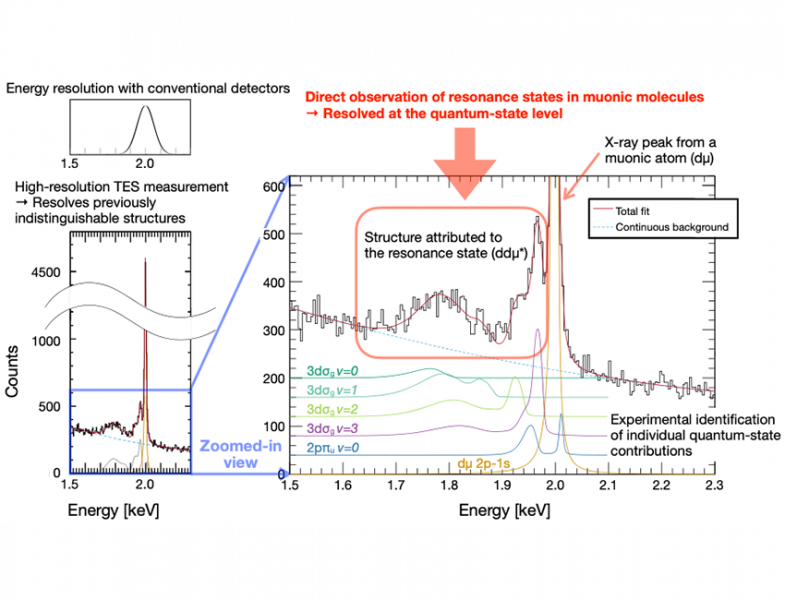
- Clear separation and observation of x-ray spectral structures arising from the resonance states of muonic molecules from those originating from muonic atoms (dµ), previously unsolved with conventional detectors, achieved using high-resolution x-ray spectroscopy with the TES detector. The obtained spectrum is in excellent agreement with the theoretical calculation, indicating that the resonance states of the muonic deuterium molecule (ddµ*) were successfully identified at the level of vibrational quantum states. This result forms the foundation for quantitatively analyzing and verifying molecular formation processes in µCF for each quantum state.
(Modified from Y. Toyama et al., Science Advances (2026) )
As a result of this quantitative identification, the study demonstrated that the previously overlooked reaction pathway via the resonance state plays a primary role in the molecular formation process in µCF. Furthermore, the findings suggested the existence of a “fast track” that bypasses the muonic molecular formation reaction (the rate-limiting step in µCF) to transition directly into a state where fusion occurs, yielding results highly consistent with theoretical predictions. Through high-resolution x-ray spectroscopy using a TES detector, this achievement has resolved the core unresolved issue of µCF research—the mismatch between theoretical and experimental reaction rates—bringing a breakthrough to the field. Having reached the stage where muonic molecules can be directly observed and identified at the quantum state level, µCF research has advanced significantly: from relying on ambiguous theoretical models to a new era where reaction processes based on quantum states can be verified through precision experiments. The research findings published in Science Advances, an international scientific journal of the American Association for the Advancement of Science (AAAS), on Wednesday, 15 April at 2:00 PM (EST) / Thursday, 16 April at 3:00 AM (JST).
Moving forward, by applying this methodology to reaction systems that are more efficient, such as deuterium-tritium mixtures, further advancements are expected in elucidating the complete µCF reaction cycle and in research geared toward energy production applications.
This achievement establishes a crucial scientific foundation that will guide future research toward realizing highly efficient muon catalyzed fusion, promoted under the Japanese Cabinet Office’s Moonshot Research and Development Program (Goal 10), managed by the Japan Science and Technology Agency (JST). The high-resolution x-ray spectroscopy techniques established in this study, along with the insights uncovering the physical role of resonance states, provide clear guiding principles for research strategies targeting µCF efficiency enhancement. Ultimately, this is expected to further accelerate research and development toward the “Innovative muon catalyzed fusion technology for practical applications.”
Research Highlights
- Achieved the world’s first direct observation of the resonance state of muonic molecules, which is the key to elucidating the molecular formation process in muon-catalyzed fusion (µCF).
- Established a method to isolate and quantitatively observe muonic molecules for each quantum state using high-resolution x-ray spectroscopy with a TES detector.
- Quantitatively demonstrated that the reaction pathway via the resonance state functions as the primary molecular formation process, resolving the discrepancy between theoretical and experimental reaction rates in µCF.
- Observed transitions include a “fast track” that bypasses the rate-limiting process, presenting a new framework that enables the understanding and verification of µCF reactions.
- Significantly advanced the fundamental understanding towards achieving highly efficient µCF.
Participating institutions and representatives for the joint press release in Japan
Chubu University Shinji Okada
Tohoku University Yasushi Kino
KEK / J-PARC Center Patrick Strasser
RIKEN Tadashi Hashimoto
Tokyo Metropolitan University Takuma Okumura
Rikkyo University Shinya Yamada
WPI-QUP, KEK Toshiyuki Azuma
Kavli IPMU, The University of Tokyo Tadayuki Takahashi
National Institute for Fusion Science Shinji Okada (joint appointment)
Funding and Research Support
This work was partially supported by the following funding sources and research programs:
- JSPS KAKENHI (Grant Numbers: JP18H05457, JP18H05463, JP18H05458, JP18H05461, JP24K00549, JP18H03714, JP23H00120, JP23H03660, JP20K15238, JP24K06911, JP23K13130)
- Joint Research Program of the National Institute for Fusion Science (NIFS23KIIF031, NIFS23KIIF032)
- HPCI System Research Project (hp240146, hp250118)
- JST Moonshot Research and Development Program (JPMJMS25A4)
- Muon Science Experimental Proposal at the Institute of Materials Structure Science (IMSS), High Energy Accelerator Research Organization (KEK) (2019MS01)
Paper Details
Journal: Science Advances
Title: Direct observation of muonic molecules in resonance states critical to muon catalyzed fusion
Authors: Y. Toyama1∗, T. Azuma2,3, D.A. Bennett4, W.B. Doriese4, M.S. Durkin4,5, J.W. Fowler4, J.D. Gard4,5, T. Hashimoto6 , R. Hayakawa3, Y. Ichinohe7, K. Ishida8, S. Kanda8, N. Kawamura8, Y. Kino9, R. Konishi9, Y. Miyake8, K.M. Morgan4, R. Nakashima9, H. Natori8, H. Noda10, G.C. O’Neil4, S. Okada1,11,12, T. Okumura13, K. Okutsu9, C.D. Reintsema4, K. Sasaki9, T. Sato14, D.R. Schmidt4, K. Shimomura8, P. Strasser8, D.S. Swetz4, T. Takahashi15, M. Tampo8, H. Tatsuno16, J.N. Ullom4,5, I. Umegaki8, S. Watanabe17, S. Yamada18, T. Yamashita9∗
- Center for Muon Science and Technology, Chubu University
- Atomic, Molecular and Optical Physics Laboratory, RIKEN
- WPI-QUP, KEK
- National Institute of Standards and Technology (NIST), USA
- University of Colorado, Boulder, USA
- RIKEN Pioneering Research Institute, RIKEN
- RIKEN Nishina Center, RIKEN
- High Energy Accelerator Research Organization (KEK)
- Department of Chemistry, Tohoku University
- Astronomical Institute, Tohoku University
- Department of Mathematical and Physical Sciences, Chubu University
- National Institute for Fusion Science (NIFS)
- Department of Chemistry, Tokyo Metropolitan University
- Department of Physics, Meiji University
- Kavli IPMU, The University of Tokyo
- Department of Physics, Tokyo Metropolitan University
- Institute of Space and Astronautical Science (ISAS), JAXA
- Department of Physics, Rikkyo University
- Corresponding Authors
DOI: 10.1126/sciadv.aed3321
URL: https://www.science.org/doi/10.1126/sciadv.aed3321
Glossary terms
(1) Muon
A muon possesses properties very similar to an electron, having the same negative charge but a mass approximately 207 times greater. It has a short lifetime of about 2.2 µs (microseconds, or one-millionth of a second) and ultimately decays into an electron and other particles.
(2) Muon catalyzed fusion: µCF
A process where a muon binds with hydrogen isotopes (such as deuterium) in place of an electron, creating an exotic molecule known as a “muonic molecule.” In this molecule, because the muon is about 207 times heavier than an electron, the atomic nuclei are drawn extremely close together. As a result, nuclear fusion occurs without the need to create high-temperature plasmas like those found in the sun. Furthermore, after the reaction, the muon is released and acts as a “catalyst,” repeatedly triggering fusion multiple times for as long as its lifetime allows.
(3) Resonance state
A metastable state with a finite lifetime, which decays by emitting radiation—such as x-rays—when transitioning to a more stable state.
(4) Superconducting transition-edge sensor (TES) microcalorimeters
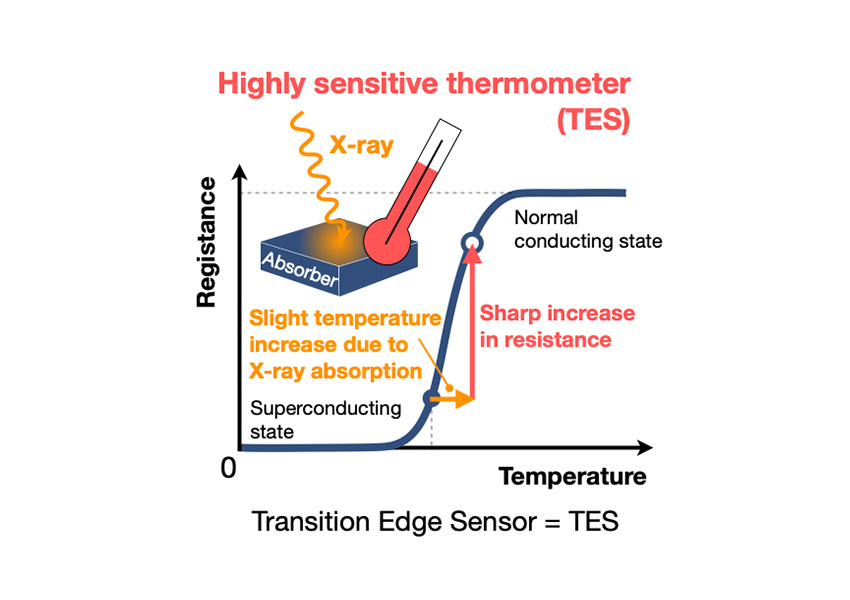
A type of device (microcalorimeter) that measures the energy of absorbed x-rays as a minute increase in temperature, utilizing a superconductor as the temperature sensor. Because the electrical resistance of a superconductor changes abruptly near its transition temperature, even the slightest temperature variations can be detected with high sensitivity as electrical signals. By leveraging this characteristic, the TES detector achieves extremely high energy resolution, enabling the observation of fine spectral structures that are difficult to distinguish using conventional semiconductor detectors.
(5) JST Moonshot R&D Program (Goal 10)

One of the ten challenging research and development programs promoted by Japan. Goal 10 aims to “realize a dynamic society that is in harmony with the global environment and free from resource constraints through the multifaceted utilization of fusion energy by 2050.”
This study is positioned as foundational research contributing to the improved efficiency of µCF, serving as part of the R&D efforts directed toward the “social implementation of innovative muon-catalyzed fusion technology” promoted under this program.
Media Contact
【Scientific Inquiries】
Assistant Professor Yuichi Toyama Chubu University
E-mail:toyama[at]fsc.chubu.ac.jp ※Please replace [at] in the address with @
Professor Shinji Okada Chubu University
E-mail:sokada[at]fsc.chubu.ac.jp ※Please replace [at] in the address with @.
【Media Inquiries】
Public Relations Center, Chubu University
E-mail:chubu-info[at]fsc.chubu.ac.jp ※Please replace [at] in the address with @.