The Department of Computer Science conducts research in four major areas: Information and Communication Systems, Media Informatics, Intelligent Informatics, and Computational Engineering.
Our laboratories cover a broad range of topics, including artificial intelligence, computer vision, speech and media processing, data mining, information security, symbolic computation, digital twins, and human-centered intelligent systems.
Information and Communication Systems
This area addresses information systems that bridge the physical world and cyberspace, together with AI- and data-driven technologies for tackling societal problems.
Kimura Lab.
Digital Twin Computing Laboratory
Keywords: digital twins, cyber-physical systems, IoT sensing, numerical simulation, AI-assisted reverse engineering
Kimura Lab. studies cyber-physical systems and digital twin computing. The lab develops methods for constructing digital twins of real-world environments by integrating IoT sensor data, numerical simulation, and AI-assisted reverse engineering, with the goal of identifying root causes, predicting future states, and supporting engineering decision-making.
Tu Lab.
Intelligent Social Informatics Laboratory
Keywords: applied AI, social data analysis, tourism analytics, land-use assessment, smart agriculture
Tu Lab. applies AI, image processing, and data analysis to real-world social issues. Current projects include land-use assessment from aerial imagery using large language models, tourism analytics based on license-plate recognition, childcare information support, esports coaching using game AI techniques, and plant disease diagnosis for agricultural digital transformation.
Media Informatics
This area aims to understand human perception and to realize advanced recognition capabilities on computers and robots.
Usami Lab.
Computer Vision Laboratory
Keywords: computer vision, medical image analysis, physics-based vision, real-world sensing, generative AI
Usami Lab. focuses on computer vision, image processing, and machine learning, particularly deep learning. Research topics include lesion detection, classification, segmentation, and 3D shape reconstruction in medical images; image understanding based on light, geometry, and physics-based models; spatio-temporal modeling from videos and sensor data; and generative AI for learning support, data augmentation, and model evaluation.
Yamashita Lab.
Machine Perception Laboratory
Keywords: machine perception, deep learning, face image analysis, pedestrian detection, object tracking
Yamashita Lab. develops technologies that enable computers and robots to perceive the world in a human-like manner. The lab applies deep learning to face image analysis—including facial landmark detection and attribute estimation—as well as to pedestrian detection for intelligent vehicles and object tracking under appearance variation.
Yamamoto Lab.
Sound and Media Communication Laboratory
Keywords: speech recognition, spoken dialogue systems, automatic captioning, speaker recognition, music information processing
Yamamoto Lab. studies speech and media communication technologies. Research topics include spoken dialogue interfaces, automatic captioning and speech translation for lecture content, and large-vocabulary continuous speech recognition. The lab also works on robust speech processing under noise and reverberation, environmental sound recognition, speaker recognition with anti-spoofing countermeasures, and music information processing.
Intelligent Informatics
This area focuses on intelligent signal processing, machine learning, neural models, data mining, human impressions, and biologically inspired AI.
Itai Lab.
Intelligent Signal Processing Laboratory
Keywords: signal processing, brain-computer interfaces, biosignals, gait sound analysis, environmental electromagnetic waves
Itai Lab. studies signal processing and digital data analysis, with applications to biosignals, human motion, and environmental measurements. Research topics include EEG-based brain-computer interfaces using SSVEP extraction, footstep analysis for personal identification and age-related trait estimation, motion-capture-based modeling of walking sounds, and anomalous signal detection in environmental electromagnetic waves.
Nakamura Lab.
Computational Physics Laboratory / Human-Robot Interaction
Keywords: computational analysis of comics, sound symbolism, onomatopoeia, human impressions, human-robot interaction
Nakamura Lab. studies how human impressions and expressive cues can be modeled and used in intelligent systems. Research topics include computational analysis of comics, manga engineering, sound symbolism, onomatopoeia, intuitive interface design based on onomatopoeic expressions, mappings from onomatopoeia to visual and musical patterns, and human-robot interaction.
Matsui Lab.
Data Mining Laboratory
Keywords: machine learning, data mining, reinforcement learning, financial text mining, bioinformatics
Matsui Lab. studies machine learning and data mining, with applications to medical data analysis, financial data analysis, and bioinformatics. Research topics include reinforcement learning algorithms and their application to financial trading strategies, stock price prediction using financial text mining, anomaly detection in cardiopulmonary bypass operation records, and homology search for multi-domain proteins.
Morita Lab.
Information Systems Laboratory
Keywords: neural networks, spiking neural networks, machine learning, educational support systems
Morita Lab. studies neural network models and brain-inspired algorithms. The lab focuses on spiking neural networks, which represent time-varying information as spike sequences, and develops machine-learning-based educational support tools, including systems for visualizing and analyzing learning activities in music education.
Yamauchi Lab.
Biologically Inspired Intelligent Processing Laboratory
Keywords: biologically inspired AI, neural networks, continual learning, variable selection, driver behavior modeling, document clustering, MPPT control
Yamauchi Lab. studies biologically inspired methods for intelligent information processing. Research topics include continual learning in neural networks with sleep-like consolidation phases that integrate new knowledge with past knowledge, and feedforward MPPT control for photovoltaic cells using incrementally trainable neural networks.
Research topics:
- Biologically inspired machine learning algorithms
- Quick variable selection
- Modeling of human driver behavior
- Applications of machine learning
- Document clustering
Computational Engineering
This area addresses the mathematical, logical, cryptographic, and computational foundations of computer science.
Okui Lab.
Symbolic Computation Laboratory
Keywords: symbolic computation, automated equational reasoning, theorem proving, declarative programming, DNA computing
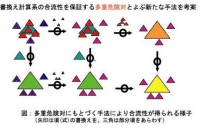
Okui Lab. studies symbolic computation and the foundations of programming languages, including automated equation solving, theorem proving, and rewrite systems with confluence analysis. The lab also develops declarative programming languages based on equations, as well as visual and interactive programming environments for mathematical and logical reasoning.
Research topics:
- Rewrite systems and functional/logic programming
- Automated equational deduction
- DNA computing
Tadaki Lab.
Cryptography, Probability, Quantum Computing, and Algorithmic Randomness Laboratory
Keywords: information security, cryptographic protocols, algorithmic randomness, quantum computing, probability theory
Tadaki Lab. studies information security from the perspective of algorithmic randomness. Research topics include provable security, cryptographic protocols, privacy protection, computation on encrypted data, and the operational foundations of cryptography. The lab also investigates quantum computing models, operational characterizations of probability, and foundational questions related to quantum mechanics.